


Genuine 1M x 3MM Breakaway Break Away Cable, Trailer Caravan Safety Coupling Cable, With Heavy Duty Burst Ring, Stainless Steel Cable and Carabiner, Red
£4.99
- Heavy Duty Breakaway Cable Suitable for Trailers, Caravans and Most Horseboxes
- Breakaway Cable: Stainless Steel, heavy duty. 1 meter long, 3mm in diameter. Red PVC Coated for high visibility.
- Vehicle fitting: Carabiner. Heavy Duty, Stainless Steel. Size 80mmx40mm.
- Trailer fitting: Burst Ring. Heavy duty, Zinc galvanisation. 56mm diameter, 5.5mm thick,
- Red PVC coated. For high visibility.
- 1pc/bag.
- Fits most makes of trailer and caravan braked couplings, including Indespension, Bradley, Peak, Al-ko and any fitted with a ratchet type handbrake. Designed to apply the brakes in the unlikely event of the trailer or caravan becoming detached from the towing vehicle.
- The cable should be hooked around the towball or ideally attached to a loop provided on the towbar.
- Please read the important information contained in the ‘Breakaway Cable Safety Information’ document below. It is essential that a breakaway cable is in good condition and fitted at all times when towing.
- It is also recommended that a spare breakaway cable is carried at all times when towing. Should the one fitted become damaged during a journey it would be dangerous and illegal to continue towing either without one fitted or if it were damaged in any way.
Breakaway Cables
When towing a braked trailer or caravan it should be comforting to know that should, in the very unlikely event of becoming unhitched the brakes would be applied to bring it to a stop using a breakaway cable. Because the consequences of not having one fitted correctly is so serious it is a legal requirement that all braked trailers and caravans built after 1st October 1982 must be fitted with this safety feature.A breakaway cable is made from steel cable, sometimes plastic coated it is connected between towing vehicle & trailer and should pull tight to engage the trailer’s brakes allowing the towed vehicle to come to a halt away from the towing vehicle should it become unhitched.
Most tow bars have either a drilled hole or attachment specifically intended to accept the breakaway cable’s spring clip.
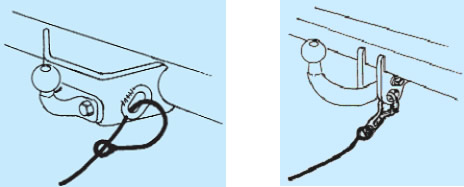
Some styles of towing bracket do not have a place intended for the spring clip, like ones fitted with detachable tow balls. In these instances, the cable can be looped around the tow ball.
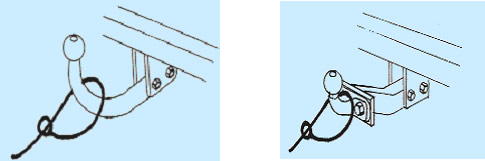
The breakaway cable should never become taught, it should be of sufficient length to reach and ensure it does not pull the handbrake on when turning a corner. It is advisable that the breakaway cable fitted should be approved by the manufacturer of the coupling.
Even though rare, most incidences of the trailer or caravan becoming detached happen within a short time of setting off, it is usually because part of the hitching up the vehicle has not been carried out correctly.
Other instances have been noted when a caravan fitted with an Al-ko stabiliser head has been hitch up to a standard two-bolt fixing flange towball. An extended neck towball is required for use with these stabiliser heads. Please always ensure you have all the correct equipment fitted prior to towing.
Trailers that are not fitted with brakes require a secondary coupling, this is usually either a chain or cable which is sufficiently strong enough to continue to tow the trailer and short enough not to allow the coupling to come into contact with the ground should the trailer become detached from the towing vehicle.


